Too Many AI Subscriptions? How Creators Consolidate in 2026
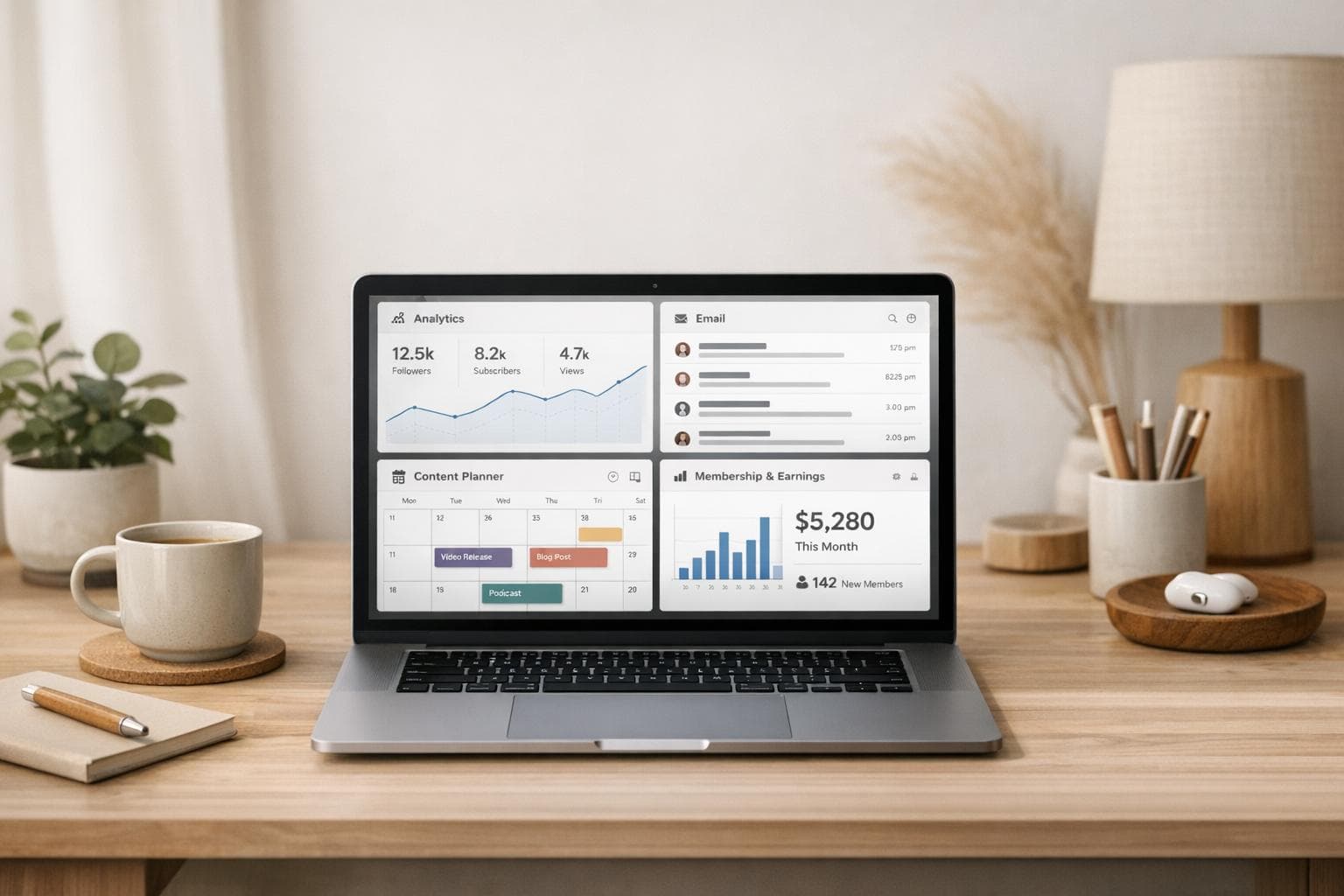
The average content creator in the US now spends $200–$300 per month (up to $3,600 annually) across AI tools — and uses less than a third of what they're paying for. The tools have multiplied faster than the workflows have adapted. ChatGPT Plus, Midjourney, an AI video tool, a separate voice generator, a writing assistant, and a design platform — each $20–$60/month — add up to a hidden tax on your creative output.
This guide gives you a practical April 2026 framework to audit your subscriptions, identify what to cut, and consolidate intelligently — without losing capability.
Key Numbers
- $267/month — average cost for creators running 5–10 separate AI subscriptions
- 130+ hours/year lost switching between tools and re-establishing context
- 70% of features across competing AI tools overlap with each other
- 40% productivity drop from chronic context-switching between platforms
Step 1: The Subscription Audit (April 2026 Framework)
Before consolidating, map your actual usage. Open your bank or credit card statement and list every recurring AI tool charge. Then for each tool, answer three questions:
- When did I last use it this month? (Never = cut immediately)
- What can I only do here that I can't do elsewhere? (Unique = keep; duplicated = eliminate)
- How much am I paying per output unit? (Calculate cost per article, image, or video)
The 30-Day Rule
Any AI tool you haven't actively used in the past 30 days is a candidate for cancellation. Tools in "I might need this later" status cost you on average $22/month each. Cancel first, re-subscribe if needed.
Current April 2026 AI Subscription Pricing Reference
| Tool | Category | April 2026 Price | What it does uniquely |
|---|---|---|---|
| ChatGPT Plus | Text / chat | $20/mo | GPT-5.4 access, Deep Research, real-time search |
| Claude Pro | Text / long context | $20/mo | Claude 4.6 access, 200K context, Projects |
| Gemini Advanced | Text / multimodal | $19.99/mo (Google One AI Premium) | Gemini 3.1 Pro, Deep Research, Google Workspace integration |
| Midjourney | Image generation | $10–$60/mo (Basic–Pro) | Proprietary aesthetic, community, strong stylistic control |
| ElevenLabs | Voice / TTS | $5/mo Starter, $22/mo Creator | Realistic voice cloning, 70+ languages |
| Jasper | AI writing / marketing | $49/mo Creator | Brand voice training, marketing templates |
| Runway Gen-4 | AI video | $15–$95/mo | Video-to-video, motion brush, cinematic control |
| Canva Pro | Design / visuals | $15/mo | Templates, brand kit, resize, presentation tools |
| Otter.ai | Transcription | $16.99/mo Pro | Meeting transcription, speaker ID, search |
| Descript | Video + audio editing | $24/mo Creator | Text-based video editing, overdub voice cloning |
A typical creator stack of ChatGPT Plus + ElevenLabs Creator + Midjourney Basic + Runway Basic + Canva Pro alone totals $82/month. Add Jasper or any writing assistant and you're quickly above $130/month — often with significant feature overlap between the text tools.
Step 2: Identify the Overlap Zones
Most creator stacks have three major overlap zones where you're paying twice for the same capability:
Zone 1: Text Generation Overlap
ChatGPT Plus, Claude Pro, Gemini Advanced, and Jasper all generate text. For most creators, one flagship model (GPT-5.4, Claude 4.6, or Gemini 3.1 Pro) covers 90%+ of writing tasks. Jasper's main unique value is brand voice templates — if you don't have a large content team enforcing brand consistency, it's likely redundant.
Zone 2: Voice and Audio Overlap
If you're paying separately for ElevenLabs, Descript Overdub, and a podcast editing tool, you almost certainly have overlap. ElevenLabs' Creator plan at $22/month covers most voice generation and cloning needs. Access it through an aggregator platform and you may not need the standalone subscription.
Zone 3: Image Generation Overlap
Midjourney, DALL-E (bundled with ChatGPT Plus), Adobe Firefly (bundled with Creative Cloud), and Canva AI Image all generate images. Unless Midjourney's specific aesthetic is core to your brand, you may be paying for two or three image tools that functionally overlap.
Step 3: The Consolidation Decision
After mapping your stack, you'll typically fall into one of three consolidation paths:
Path A: The Aggregator Approach
Use a single platform that provides access to multiple frontier models under one subscription. This works best when you use text, image, voice, and video tools regularly but don't need the deepest specialized features of any one platform.
Platforms like Soloa AI integrate 50+ AI tools — including GPT-5.4, Claude 4.6, Gemini 3.1 Pro, ElevenLabs voice, and image generation — under a single credit-based dashboard. For creators spending $200+/month across fragmented tools, consolidating to a $29.99/month Pro plan (300 credits) or $79/month Plus plan (900 credits) often represents savings of $100–$180/month.
"Soloa lets me access all the premium AI models I was paying for separately, but for a fraction of the cost and all in one place." — Ogwu Ojochegbe Emmanuel, Product Designer
Path B: The Anchor + One Specialist Approach
Keep one best-in-class tool for your primary creative output (e.g., Midjourney if your brand aesthetic is tightly tied to its output), and use a multipurpose aggregator for everything else. This retains creative differentiation while eliminating waste.
Example stack for a video creator in April 2026:
- Runway Gen-4 ($15/mo) — for unique video generation that defines your aesthetic
- Soloa AI Pro ($29.99/mo) — for all text, voice, image support, and model comparison
- Total: ~$45/mo vs. previous $200+/mo stack
Path C: The Flagship Model Approach
For text-heavy creators (writers, newsletter authors, SEO teams), a single frontier model subscription often replaces five separate writing tools. GPT-5.4 via ChatGPT Plus ($20/mo) or Claude 4.6 via Claude Pro ($20/mo) covers drafting, editing, research, outlines, SEO meta, social posts, and email — in one interface, with one login.
What to Look for in a Consolidated AI Platform (April 2026 Checklist)
When evaluating whether an aggregator platform is worth switching to, verify these points:
- Current flagship model access: Does it include GPT-5.4, Claude 4.6, and Gemini 3.1 Pro — the April 2026 frontier models? Platforms still listing GPT-4, Claude 3.5, or Gemini 2.0 as their premium offering are behind the curve.
- Multimodal coverage: Text, image generation, video creation, and voice synthesis should all be present. Verify each is production-ready, not just a beta toggle.
- Credit transparency: Can you see exactly how many credits each task consumes before running it? Hidden credit costs are the primary complaint about aggregator platforms.
- Credit portability: Do unused credits roll over? Can you buy lifetime credits that don't expire? A platform that forces use-it-or-lose-it on monthly credits recreates the same waste problem you're trying to solve.
- API access: If you automate any workflows, confirm API access is available on your target tier (not locked to the highest plan).
- Context retention across tools: The best aggregators maintain project context when you switch between text, image, and voice tasks — eliminating the re-prompting overhead that makes tool-switching so expensive in time.
Real Cost Comparison: Fragmented vs. Consolidated Stack
| Scenario | Tools | Monthly Cost | Annualized |
|---|---|---|---|
| Typical fragmented creator stack | ChatGPT Plus + ElevenLabs Creator + Midjourney Basic + Runway Basic + Canva Pro + Jasper Creator | $131/mo | $1,572/yr |
| Anchor + aggregator approach | Midjourney Basic + Soloa AI Pro | $40/mo | $480/yr |
| Full aggregator approach | Soloa AI Plus plan | $79/mo | $948/yr |
| Flagship model only (text creators) | ChatGPT Plus or Claude Pro | $20/mo | $240/yr |
Improving Workflow Efficiency — Not Just Cutting Costs
The financial saving is real, but the workflow benefit is often larger. Research on task-switching shows that workers lose an average of 23 minutes of focused work every time they switch between platforms. For a creator managing 10–15 tools daily, that's 3–4 hours of lost productive time every day — roughly 900 hours per year.
Context-switching between tools creates invisible friction: re-establishing prompts, copying outputs, reformatting content, re-logging in. Integrated platforms eliminate most of this friction by maintaining project context, enabling side-by-side model comparison, and keeping assets in one workspace.
The "Four-Model Review" Workflow
For high-stakes content — product launches, SEO articles, campaign briefs — aggregator platforms enable a "Four-Model Review" process that used to require four separate subscriptions:
- Draft with GPT-5.4 (strong for structured output)
- Fact-check and refine with Gemini 3.1 Pro (strong for real-time search integration)
- Tone and clarity review with Claude 4.6 (strong for nuanced writing critique)
- Generate supporting visuals with an image model — all without leaving the same dashboard
This approach extracts the best from multiple frontier models without the overhead of managing separate accounts. Access to tools like AI image generation and AI speech generation in the same workspace is what makes this practical at scale.
Practical Steps to Consolidate This Month
- List every AI subscription charge from the past 3 months of billing statements.
- Mark tools you haven't used in 30+ days — cancel those today.
- Identify your primary creative output type (writing, video, image, audio) and find one best-in-class tool for that specific output.
- Use an aggregator for everything else — text support, image variation, voice narration, research.
- Run the consolidated stack for one full month before committing annually — credit usage patterns often surprise in month one.
- Set billing alerts at 50%, 80%, and 100% of your credit allocation so usage spikes don't create surprise charges.
The goal isn't minimalism for its own sake. It's eliminating the invisible tax of tool sprawl — the context-switching, the duplicate billing, the 30-minute onboarding every time a new AI tool launches. Streamline your stack around your actual creative workflow, and the tools get out of the way.
FAQs
What are the current flagship AI models in April 2026?
The April 2026 frontier models are GPT-5.4 (OpenAI), Claude 4.6 (Anthropic), and Gemini 3.1 Pro (Google DeepMind). When evaluating aggregator platforms, confirm access to these specific models — not earlier generations like GPT-4, Claude 3.5, or Gemini 2.0, which are now two to three capability generations behind.
How much can I realistically save by consolidating?
Creators running 5–10 tools at $20–$60/month each typically save $80–$180/month by consolidating to an aggregator plus one anchor specialist tool. Annualized, that's $960–$2,160 in recovered spend — not including the productivity time recovered from reduced context-switching.
Will I lose quality by consolidating to one platform?
For most content creation tasks — drafting, editing, image generation, voice narration — no. The quality gap between aggregator-accessed frontier models and direct subscriptions is negligible. You may lose specialized features (e.g., Midjourney's precise aesthetic control, or ElevenLabs' deepest voice cloning features) — but for those specific capabilities, the Anchor + Aggregator approach lets you keep one specialist while eliminating the rest.
What is the best all-in-one AI platform for creators in April 2026?
The best platform depends on your primary output type. For creators who produce a mix of written content, visuals, and audio, Soloa AI provides access to GPT-5.4, Claude 4.6, Gemini 3.1 Pro, image generation, and ElevenLabs-powered voice tools under one credit-based subscription starting at $9.99/month. For text-only creators, a single Claude Pro or ChatGPT Plus subscription at $20/month may be all that's needed.
How do credit-based AI pricing systems work?
Credit-based systems deduct credits per AI operation — simpler tasks (a text response) cost fewer credits than complex ones (generating a video). The key advantages are that you pay for what you use and that unused credits on platforms like Soloa AI roll over or convert to lifetime credits on plan upgrade. This avoids the "use it or lose it" waste that fixed-seat subscriptions create.
All-in-One AI Platform
Try These AI Tools Free on Soloa
50+ AI models for image, video, voice, and music. One subscription, no switching between tools.