Top 5 AI Voice Generators for Business in 2026
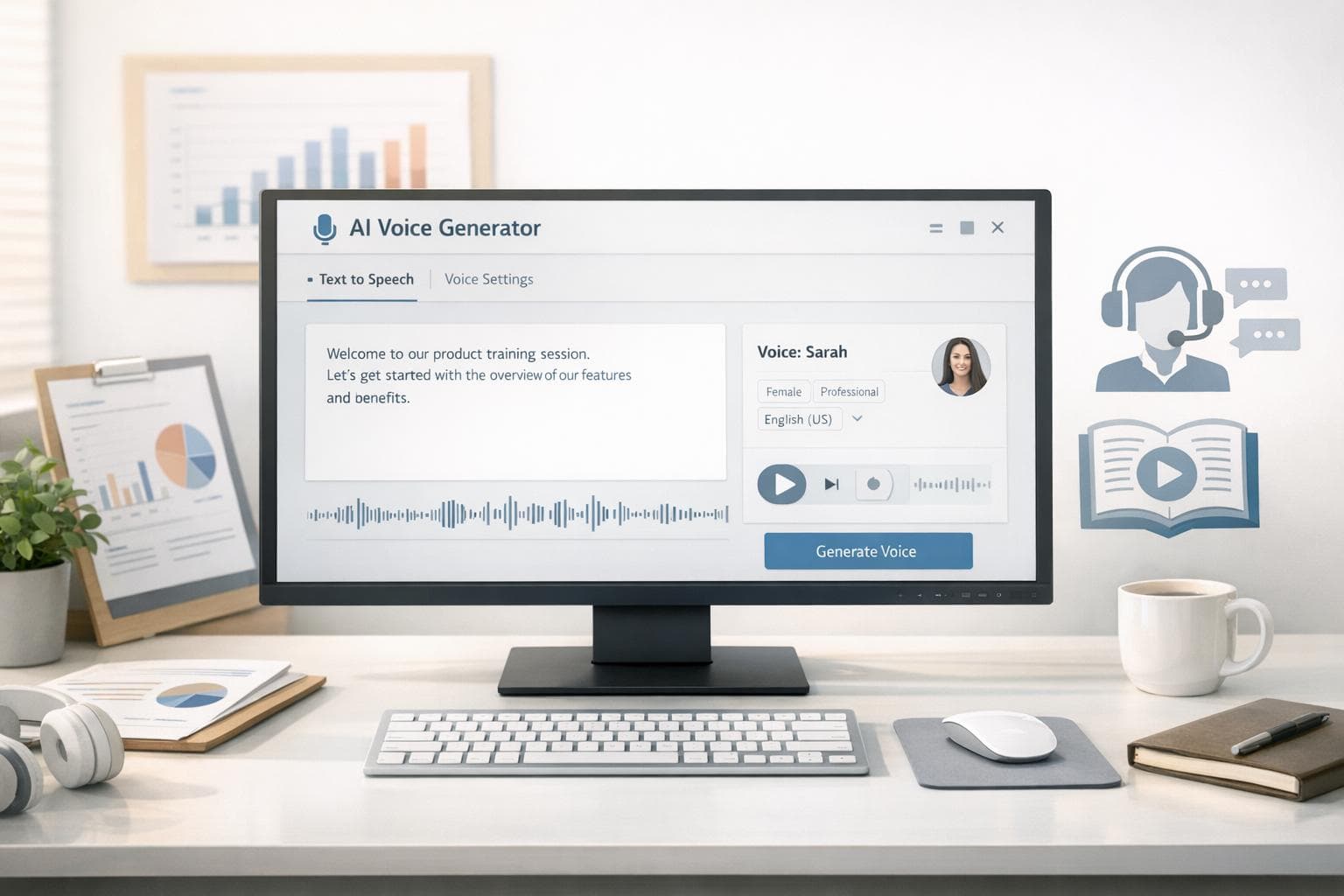
AI voice generators are transforming how businesses create audio content — offering natural-sounding voices, multilingual options, and integrations with existing tools. Whether you're producing training modules, marketing content, or customer service bots, these platforms streamline workflows and reduce costs compared to hiring voice actors. Here's a comparison of the top five AI voice generators for businesses in April 2026:
- Soloa AI: A multi-purpose platform combining voice, text, image, and video creation. Best for teams needing an all-in-one content solution. Pricing starts at $9.99/month.
- Murf AI: Ideal for corporate training and video syncing. Offers 200+ voices in 20+ languages. Plans start at $19/month.
- ElevenLabs: Known for ultra-realistic voices with emotional depth. Great for audiobooks, podcasts, and real-time AI agents. Starts at $5/month (Starter); $22/month Creator for voice cloning.
- WellSaid Labs: Focused on studio-quality voiceovers for enterprise training and internal communications. Pricing starts at $50/month.
- LOVO AI: Specializes in expressive voices for social media and marketing. Includes a built-in video editor. Plans start at $24.99/month.
Quick Comparison (April 2026 Pricing)
| Platform | Starting Price | Voice Cloning Tier | Best For | Voice Library |
|---|---|---|---|---|
| Soloa AI | $9.99/month | Via ElevenLabs integration | Multi-format content teams | 120+ voices, 32 languages |
| Murf AI | $19/month | Business plan ($66–$79/mo) | Corporate training, video sync | 200+ voices, 20+ languages |
| ElevenLabs | $5/month (Starter) | $22/month (Creator) | Audiobooks, podcasts, real-time AI | 1,200+ voices, 74+ languages |
| WellSaid Labs | $50/month (Creative) | Custom voice (enterprise) | Enterprise-grade training | 120+ voices, English only |
| LOVO AI | $24.99/month | Pro+ plan | Social media, marketing | 500+ voices, 100+ languages |
Each platform offers unique strengths. For highly realistic voices, ElevenLabs stands out. If you're creating training materials, WellSaid Labs or Murf AI may suit your needs. For diverse content creation, Soloa AI offers an all-in-one solution, while LOVO AI excels in emotionally rich voiceovers for marketing. Choose based on your specific use case, budget, and scalability needs.
How We Evaluated These AI Voice Generators
To assess these platforms, we focused on criteria that matter most to businesses in 2026: long-form voice quality, security compliance, business feature depth, and pricing scalability. We tested long-form scripts (up to 20 minutes), verified security compliance documentation, and evaluated API integration capabilities.
We concentrated on three main areas: how natural the voices sound in practical use, the business-specific features offered by each platform, and how pricing adapts to both small teams and large enterprises. These consistent benchmarks helped us gauge each platform's strengths and weaknesses.
Voice Quality and Natural Sound
Delivering a natural voice means maintaining steady pacing, tone, and cadence across extended scripts. We used a variety of scripts, from short marketing lines to detailed 20-minute training modules. Key aspects: long-form stability, emotional nuance, and pronunciation accuracy for complex technical terms and brand names. While some AI models generate conversational audio in as little as 75ms, speed is irrelevant if the output feels robotic or loses flow midway through a paragraph.
Features for Business Use
We examined how well each platform integrates into existing systems, such as Learning Management Systems and content management tools. API access was a priority for developers embedding voice generation into apps and customer service bots. Security and compliance — SOC 2 Type II, GDPR alignment, and private architectures — were critical factors for healthcare and finance deployments.
Pricing and Growth Options
Pricing structures range from free or starter plans (under $20/month) to business tiers priced between $60 and $160 per month. The jump from free testing to production-ready features typically costs $10–$22 per month additional. For instance, ElevenLabs starts at $5/month (Starter) and $22/month (Creator, with voice cloning); Murf AI at $19/month; WellSaid Labs at $50/month.
Soloa AI: All-in-One AI Content Platform with Voice Generation
Soloa AI brings voice synthesis into a single, comprehensive content creation platform. It offers businesses access to tools for text, image, video, and audio creation, all housed within one workspace. This setup simplifies workflows significantly. For example, if a script needs updating, teams can edit the text and regenerate the audio directly within the platform — no need to download and re-upload files across multiple tools.
Pricing Plans
- Free plan: 10 credits/month, community support
- Basic plan: $9.99/month — 100 credits, email support
- Pro plan: $29.99/month — 300 credits, priority support, API access
- Plus plan: $79.00/month — 900 credits, dedicated support, SLA guarantees
Standalone credit packages are also available from $4.99 (50 credits) to $59.00 (620 credits). Access Soloa's speech generation tools and AI speech capabilities from the same dashboard as image and video creation.
Murf AI
Murf AI is a full-fledged content studio combining voice generation with video editing, background music, and presentation integration. It's an excellent choice for corporate training and marketing teams that need synchronized voiceovers and visuals. Murf's Gen2 model, built on over 70,000 hours of ethically sourced speech data, achieves 98.8% word-level pronunciation accuracy in English.
"Murf's Gen2 model delivers voices that are indistinguishable from real human speech." — Murf AI
| Feature | Details |
|---|---|
| Primary Strength | Comprehensive studio with video sync and presentation tools |
| Voice Library | 200+ voices in 20+ languages |
| Pricing | $19/mo (Creator) to $66–$79/mo (Business) |
| Best For | Corporate presentations, training modules, explainer videos |
| Key Limitation | Some voices feel overly "corporate" or lack emotional nuance |
Murf also launched Falcon, a TTS API with 55ms model latency, designed for real-time applications like customer service bots.
ElevenLabs
ElevenLabs stands out for its ultra-realistic voices, making it the top choice for long-form narration (audiobooks, podcasts) and real-time conversational agents. Its industry-leading 75ms Flash model latency ensures smooth, natural interactions. In a blind test, only 22% of listeners identified ElevenLabs' AI-generated voices as synthetic.
April 2026 Pricing Update: ElevenLabs restructured plans in late 2025. The Starter plan ($5/mo) includes 30,000 characters but limited voice cloning. For full voice cloning and commercial use, the Creator plan at $22/mo (100,000 characters) is the relevant tier for most business buyers. The Pro plan ($99/mo) includes 500,000 characters for high-volume teams.
| Feature | Details |
|---|---|
| Primary Strength | Highly realistic voices with emotional depth and low latency |
| Voice Library | 1,200+ voices in 74+ languages |
| Pricing | $5/mo (Starter, 30K chars); $22/mo (Creator, voice cloning); $99/mo (Pro) |
| Best For | Audiobooks, podcasts, real-time AI agents, narration-heavy projects |
| Key Limitation | Pitch/speed adjustments consume extra credits, adding complexity |
ElevenLabs offers Instant Voice Cloning from the Creator plan ($22/mo), allowing businesses to create custom brand voices efficiently. ElevenLabs reached a $3.3 billion valuation after its 2025 Series C funding round, reflecting strong market position.
WellSaid Labs
WellSaid Labs focuses on studio-quality voiceovers with over 120 licensed voice actors, ensuring both professional quality and commercial usage rights. It's a go-to for enterprise training and internal communications where compliance and quality consistency are non-negotiable. Organizations like ARIN and 4imprint use WellSaid Labs to simplify training processes while maintaining creative control.
"WellSaid delivers human-quality text-to-speech voiceovers that power fast, frictionless creation." — WellSaid Labs
| Feature | Details |
|---|---|
| Primary Strength | Studio-quality voiceovers using licensed voice actors |
| Voice Library | 120+ licensed voices (primarily English) |
| Pricing | $50/mo (Creative) to $160/mo (Business) |
| Best For | Corporate eLearning, internal communications, enterprise training |
| Key Limitation | English-only voice library; higher starting cost deters small teams |
WellSaid Labs holds a 4.7/5 rating on G2. Users consistently commend its professional, polished narration. SOC 2 Type II certified with GDPR alignment — important for healthcare and finance.
LOVO AI (Genny)
LOVO AI, also known as Genny, specializes in delivering expressive, emotionally rich voiceovers. Its built-in video editor and third-party asset library make it a strong choice for social media and marketing projects that need creative storytelling. With over 500 voices in 100+ languages, LOVO offers "angry," "joyful," and "inspirational" tones to bring brand stories to life.
| Feature | Details |
|---|---|
| Primary Strength | Expressive voices with integrated video editing |
| Voice Library | 500+ voices across 100+ languages |
| Pricing | $24.99/mo (Basic) to $74.99/mo (Freelancer); Pro plan often discounted to $24 |
| Best For | Marketing content, social media, creative projects requiring emotional depth |
| Key Limitation | May not match ElevenLabs' realism for long-form narration |
Rated 4.4/5 on G2. Best for marketing-focused teams where emotional voice quality and built-in video editing add more value than raw narration realism.
Which Tool Works Best for Different Business Needs
Corporate Training and Internal Communications
WellSaid Labs leads for corporate training — licensed voice actors, word-level pronunciation control, and SOC 2/GDPR compliance for regulated industries. Murf AI is strong for syncing narration to video and slides. Soloa AI handles teams creating training materials who also need image and text tools in the same workflow.
Marketing and Brand Voice
ElevenLabs is the go-to for expressive, lifelike narration in marketing content, podcasts, and global campaigns — especially with AI dubbing in 29 languages. LOVO AI offers mid-sentence emotion sliders for dynamic marketing videos. Soloa AI provides a unified platform for teams producing diverse marketing content, including AI-generated images and video alongside voice.
Customer Service and Automation
ElevenLabs is ideal for real-time IVR and conversational agents — 75ms latency with WebSocket streaming. Murf Falcon API suits pre-recorded IVR at 55ms model latency. WellSaid Labs handles enterprise-grade security for healthcare and finance IVR applications.
Pricing and Scaling
| Platform | Starting Price | Voice Cloning Entry | Pricing Model |
|---|---|---|---|
| Soloa AI | $9.99/mo | Via ElevenLabs integration | Credit-based |
| ElevenLabs | $5/mo (30K chars) | $22/mo Creator (100K chars) | Character credits |
| Murf AI | $19/mo (24 hrs/year) | Business plan ($66–$79/mo) | Annual hour-based |
| WellSaid Labs | $50/mo (Creative) | Enterprise custom | Subscription |
| LOVO AI | $24.99/mo (Basic) | Pro+ plan | Subscription |
How to Pick the Right AI Voice Generator for Your Business
Finding the right AI voice generator starts with aligning the tool to your specific needs:
- Real-time customer service bots: Prioritize latency — ElevenLabs Flash (75ms), Murf Falcon (55ms), or Cartesia Sonic (<100ms).
- Corporate training / eLearning: WellSaid Labs (licensed actors, SOC 2) or Murf AI (video sync studio).
- Social media marketing: LOVO AI (emotion sliders, built-in video editor).
- Multi-format content teams: Soloa AI for a unified text + image + voice + video workflow under one subscription.
- Voice cloning for brand: ElevenLabs Creator ($22/mo) or Fish Audio S1 for the most authentic clone results in 2026.
Before committing, take advantage of free trials. ElevenLabs offers 10,000 characters/month free. Murf provides a 10-minute trial. Test scripts of at least 3 minutes to evaluate long-form voice consistency.
For security-sensitive industries: look for SOC 2 Type II, GDPR, and data residency options before sharing any confidential scripts or customer communications with any AI voice platform.
FAQs
What is the best AI voice generator for business use in April 2026?
ElevenLabs, Microsoft Azure Neural TTS, and Murf AI are the top AI voice generators for business in 2026. ElevenLabs leads for creative and marketing content; Azure Neural TTS for high-volume regulated industries; Murf AI for corporate training. ElevenLabs' Creator plan at $22/month is the sweet spot for most business buyers — it includes voice cloning and commercial rights at a price point that makes the Starter plan ($5/mo) look limited by comparison.
How much does ElevenLabs cost for businesses in 2026?
ElevenLabs has four key tiers as of April 2026: Free (10K chars/mo), Starter ($5/mo, 30K chars), Creator ($22/mo, 100K chars + voice cloning), and Pro ($99/mo, 500K chars). For most business use cases involving voice cloning and commercial licensing, the Creator plan at $22/mo is the practical entry point.
Can AI voice generators replace human voiceover artists for corporate videos?
For standard corporate use cases — internal training, product demos, explainer content — AI voice generators now deliver quality indistinguishable from professional voiceover in user surveys. Human voiceover artists remain preferred for flagship brand campaigns, emotionally sensitive topics, and content requiring a uniquely personal delivery. A 2025 survey found 72% of corporate L&D teams had replaced at least some human voiceover with AI TTS, reducing production time and costs by up to 80%.
How do I access AI voice generation without managing multiple subscriptions?
Soloa AI integrates ElevenLabs and other TTS engines under one credit-based subscription. Teams access voice generation, image creation, and text AI tools from one dashboard starting at $9.99/month, eliminating the need for separate voice generator subscriptions.
Is Resemble AI in this comparison?
Resemble AI was not included in this Top 5 comparison focused on business platforms. It is a strong choice for custom brand voice with fine-grained prosody control — see our full 10 TTS Models Ranked article for a broader comparison including Resemble AI, Cartesia Sonic, OpenAI TTS, and Kokoro.
All-in-One AI Platform
Try These AI Tools Free on Soloa
50+ AI models for image, video, voice, and music. One subscription, no switching between tools.