Credit-Based AI vs. Subscription Models

When choosing an AI pricing model, it's all about matching your usage patterns. Here's the breakdown:
- Subscription models charge a fixed monthly or annual fee. Great for steady, predictable usage. You pay the same amount regardless of how much you use.
- Credit-based models operate on a pay-as-you-go basis. Ideal for fluctuating or project-specific needs. Costs vary based on actual usage.
- Hybrid models combine both: a base subscription plus additional credits for high-demand periods. This offers flexibility without committing to a higher plan.
Key Takeaways:
- Subscriptions provide cost stability but may lead to paying for unused resources.
- Credit-based plans align costs with usage but require close monitoring to avoid unexpected spikes.
- Hybrid models balance predictability and flexibility, fitting businesses with mixed usage patterns.
Quick Comparison:
| Feature | Subscription (Fixed) | Credit-Based (Variable) | Hybrid (Mixed) |
|---|---|---|---|
| Budget Predictability | High | Low | Medium |
| Cost Alignment | Low | High | Medium |
| Best For | Steady workflows | Seasonal/project needs | Mixed usage patterns |
For most, hybrid models - like Soloa AI's approach - offer the best balance, combining predictable subscriptions with the option to buy extra credits as needed.
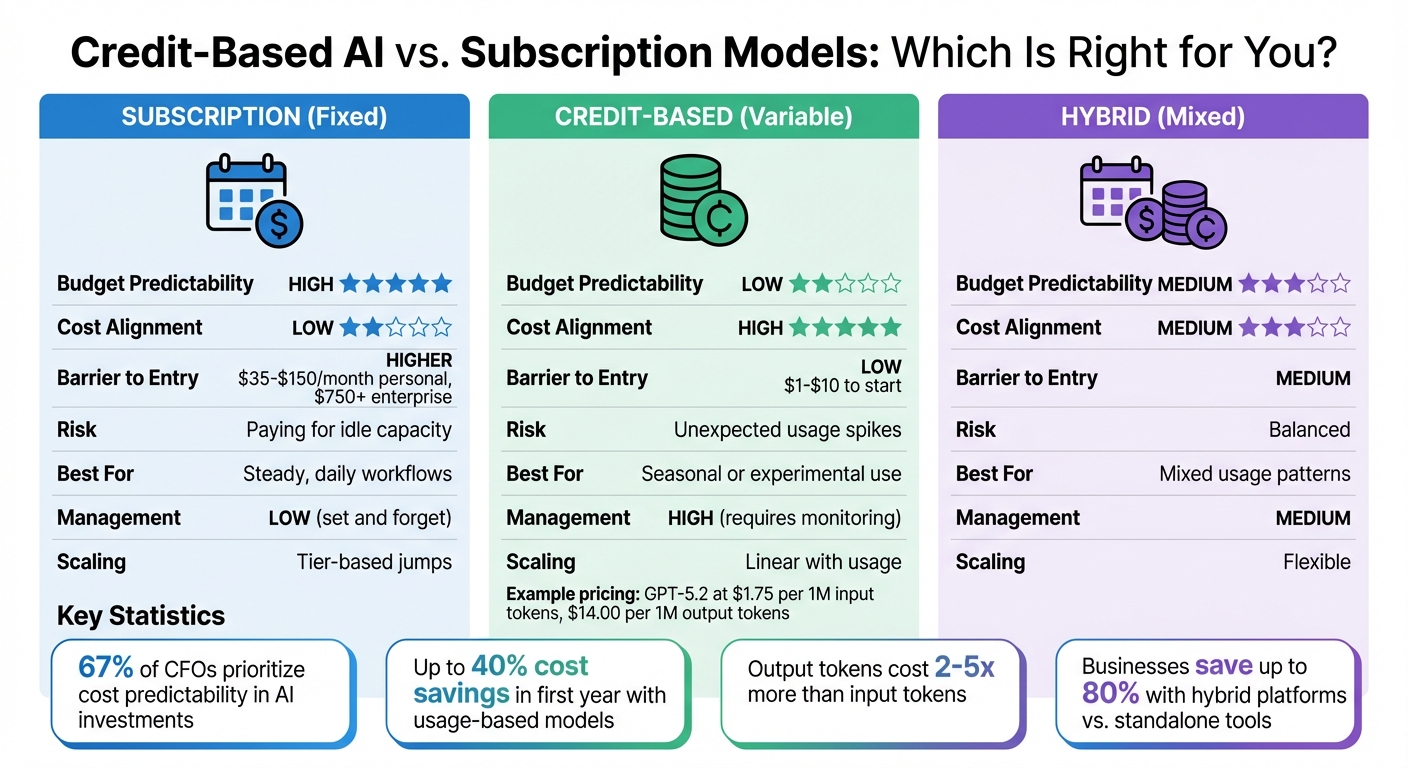
AI Pricing Models Comparison: Subscription vs Credit-Based vs Hybrid
Cost Efficiency and Financial Planning
Fixed vs. Variable Costs
Subscription models come with a set monthly or annual fee, giving you a predictable, fixed expense. Whether you use the tool daily or only a few times a month, the cost remains the same. This works well for consistent, steady usage.
On the other hand, credit-based models follow a variable cost structure. What you pay depends entirely on how much you use the service. This approach is ideal for seasonal campaigns or experimenting with AI in new projects since you only cover what you consume. In fact, usage-based models can deliver up to 40% cost savings in the first year. However, as usage stabilizes, this initial advantage often diminishes over time.
The choice boils down to a trade-off: fixed costs offer predictability but may lead to paying for unused resources, while variable costs better match spending with usage but can lead to unexpected spikes. It’s no surprise that 67% of CFOs identify "cost predictability" as a top priority when considering AI investments. These dynamics shape how controllable and predictable your budget will be.
Budget Predictability and Control
Subscriptions simplify financial planning by providing consistent monthly expenses. This predictability streamlines procurement processes and eliminates the need for constant monitoring. For many enterprise teams, this stability is a key reason to favor subscription-based pricing.
In contrast, credit-based models, while offering precise cost alignment, require close oversight. Usage spikes - like those caused by autonomous agents or resource-heavy tasks - can lead to unexpectedly high charges. Notably, output tokens often cost 2-5x more than input tokens, a detail often overlooked during budget planning. To avoid surprises, it’s smart to set usage limits and automated alerts at 50%, 80%, and 100% of your budget.
Understanding these factors is crucial when deciding which pricing model best suits your usage patterns and financial goals.
Cost Comparison Table
| Feature | Subscription (Fixed) | Credit-Based (Variable) |
|---|---|---|
| Budget Predictability | High; consistent expense | Low; fluctuates with usage |
| Cost Alignment | Low; pay regardless of use | High; pay only for usage |
| Barrier to Entry | Higher; upfront commitment | Low; start with $1–$10 |
| Risk | Paying for idle capacity | Unexpected usage spikes |
| Best For | Steady, daily workflows | Seasonal or experimental use |
Personal AI subscriptions in 2025 range between $35 and $150 per month, while enterprise AI plans start at $750 and can exceed $25,000 monthly for advanced features. For credit-based pricing, OpenAI GPT-5.2 charges $1.75 per 1M input tokens and $14.00 per 1M output tokens. Meanwhile, the Sora Video API costs between $0.10 and $0.50 per second of video generated, depending on the resolution.
Flexibility and Scalability
Aligning with Your Usage Patterns
How you use AI dictates the pricing model that works best for you. Credit-based models offer a way to prepay for variable usage, making them perfect for handling fluctuating demands. One day, you might run lightweight tasks; the next, you could tackle resource-heavy workloads - all without needing to switch plans. This flexibility suits irregular or "spiky" usage, such as seasonal marketing campaigns, experimental projects, or when teams are just dipping their toes into AI.
On the flip side, subscriptions are ideal when AI becomes part of your daily routine. If you're regularly generating content or managing high-volume workflows, a fixed monthly fee often translates to a lower cost per unit. However, there’s a catch: subscriptions can create a “use it or lose it” mindset, where you feel pressured to maximize usage simply because you’ve already paid.
By identifying which model aligns with your usage, you can set the stage for scaling your AI projects effectively.
Scaling to Meet Growing Demands
Scaling works differently depending on the pricing model you choose. With credit-based systems, costs increase in direct proportion to your usage. If you double your AI output, your spending doubles as well. This straightforward growth pattern allows for gradual expansion without sudden price jumps.
Subscriptions, however, often scale in tiers. Even a small increase in usage could push you into a higher pricing bracket, leading to a noticeable cost hike. For enterprise teams, many platforms simplify scaling by offering shared credit pools. These pools let all team members draw from a single balance, eliminating the hassle of managing individual seat limits as your team grows.
Interestingly, many providers now offer hybrid models, combining a base subscription for consistent access with credits for high-intensity tasks. This setup provides the predictability of a subscription while maintaining the flexibility to handle usage spikes. It’s a popular choice for businesses looking for a balanced and scalable solution.
AI Pricing War 2025: GPT-5 vs Claude vs Gemini - Who Wins?
sbb-itb-7afdda7
Feature Access and Administrative Simplicity
When considering cost and flexibility, how features are accessed and managed plays a big role in shaping your overall pricing experience.
Bundled Features vs. Pay-As-You-Go
Subscription models often rely on "feature gating", where advanced tools and capabilities are locked behind specific tiers like Pro or Enterprise. With a fixed monthly fee, you gain access to everything within your chosen tier, including any new features or updates that roll out over time. This bundled approach allows you to experiment freely without needing to track every individual task.
In contrast, credit-based models give you upfront access to all features but charge a varying number of credits depending on the complexity of the task. For instance, generating text might cost 1 credit, while creating a high-resolution image could take 4–8 credits. If you’re using more advanced models, expect them to consume even more credits. This pay-as-you-go setup ensures you only pay for what you use, but it can make budgeting tricky, as you’ll need to weigh the credit cost of each action before proceeding.
The trade-off is clear: subscriptions let you explore and experiment without worrying about usage tracking, while credit-based systems help control spending but may discourage frequent or extensive use due to the immediate cost tied to every feature.
This difference in access also impacts how much administrative effort each model requires.
Management Requirements
Managing a subscription is straightforward: you deal with one recurring invoice, set up seat licenses or tier levels, and you’re done. This simplicity is why 67% of CFOs value cost predictability when assessing AI investments. With fewer approval steps, procurement becomes a more streamlined process.
Credit-based systems, however, demand constant oversight. You’ll need to track usage with real-time dashboards, monitor automated alerts at key thresholds (like 50%, 80%, and 100% of your balance), and manage policies for credit expiration, refunds, and burn rates across different features. This level of monitoring can be time-intensive and requires careful planning to avoid unexpected costs.
A PwC Technology Forecast analyst sums it up well:
The future of AI pricing isn't subscription versus usage - it's finding the right blend of both that aligns vendor incentives with customer success.
| Feature | Subscription Model | Credit-Based Model |
|---|---|---|
| Access Logic | Tier-based (Basic, Pro, Enterprise) | Pay-per-feature/action |
| Management | Low; set and forget | High; requires balance monitoring |
| Budgeting | Predictable monthly/annual costs | Variable; depends on usage spikes |
| Procurement | Simplified; fewer touchpoints | Complex; requires real-time tracking |
Soloa AI: Combining Credit and Subscription Benefits
How Soloa AI Merges Both Pricing Models
Soloa AI strikes a balance between the predictability of subscriptions and the flexibility of pay-as-you-go. When you choose a monthly or annual plan, you’re given a set number of credits - starting at 300 credits for the Basic tier ($15.99/month) and going up to 5,000 credits for the Max tier ($69.99/month). If you run out of credits before the month ends, you can purchase additional credit packages that never expire. The system prioritizes using your subscription credits first and then seamlessly switches to any lifetime credits you’ve bought, so you’re never left stranded mid-project.
This setup eliminates the need to upgrade your plan during high-demand periods. For instance, you can buy a $35.99 package for 1,500 lifetime credits and keep working without interruptions. If you decide to upgrade your plan, any unused credits from your previous subscription will automatically convert into lifetime credits.
Benefits for Creators and Businesses
Soloa AI’s flexible pricing model is designed to boost productivity across a wide range of creative fields. By integrating over 50 AI tools - like GPT-5.2, Claude 4.5, Gemini 3, Sora 2, and ElevenLabs - into a single dashboard, the platform eliminates the hassle of juggling multiple logins and subscriptions. Users report saving more than $500 annually compared to maintaining separate subscriptions for text, image, audio, and video generation. For businesses, this translates to up to 80% savings when compared to using standalone enterprise-grade tools.
Product designer Ogwu Ojochegbe Emmanuel shared his experience:
Soloa lets me access all the premium AI models I was paying for separately, but for a fraction of the cost and all in one place.
The streamlined workflow allows users to transition effortlessly between tasks - such as drafting a script in Claude, creating visuals in Sora, and adding voiceovers with ElevenLabs - without needing to switch tabs or manage separate credit balances. With 99% user satisfaction and over 15,000 active creations on the platform, Soloa AI demonstrates how combining subscription benefits with credit flexibility can meet the needs of both individual creators and growing businesses.
Choosing the Right Model for Your Needs
Final Thoughts
When it comes to investing in AI tools, matching your pricing model to your usage patterns is key. If your workload is steady and predictable - like daily content creation or routine customer support - a subscription model can be a great fit. It offers budget stability and eliminates the hassle of tracking every detail of your usage. This makes it an ideal option for businesses and teams with consistent workflows.
On the other hand, for those with fluctuating needs, a credit-based model ensures you only pay for what you actually use. This approach works particularly well for testing new tools or handling project-based tasks where demand can be unpredictable.
For many, a hybrid approach offers the best of both worlds. These models combine the reliability of a base subscription with the flexibility of additional credits for peak periods. This way, organizations can stay within their budget while still being prepared for usage spikes.
To make an informed choice, consider testing the tool on a monthly plan for a few cycles to better understand your actual usage patterns. Set clear spending limits and enable automated alerts at key thresholds - like 50%, 80%, and 100% of your budget - to avoid any surprises.
Soloa AI embodies this balanced approach with its hybrid pricing model. It offers subscription tiers that include credits, along with the option to purchase lifetime credit packages that never expire. This structure allows for predictable budgeting while providing the flexibility to scale up during busy periods without committing to a full plan upgrade.
"The future of AI pricing isn't subscription versus usage - it's finding the right blend of both that aligns vendor incentives with customer success." - Industry Analyst, PwC Technology Forecast
FAQs
How can I choose between a subscription and a credit-based AI pricing model?
When deciding between a subscription plan and a credit-based pricing model, it’s essential to weigh your usage habits, budget, and need for flexibility. If your AI usage fluctuates or you’re experimenting with new tools, a credit-based model allows you to pay only for what you use. Subscriptions, however, work best for consistent, predictable workloads with a fixed monthly cost.
To make the right choice, estimate your monthly usage - whether it’s for text generation, image creation, or video synthesis - and compare the total costs for both models. If your usage is below the subscription’s flat rate, credits might be the more economical choice. But if you prefer uninterrupted access without the hassle of tracking individual usage, a subscription can save you time and effort.
Platforms like Soloa AI offer both pricing options, giving you the flexibility to pick what suits your needs. Plus, with access to over 50 AI tools in one place, Soloa AI makes it easier to scale your projects or streamline workflows, no matter which model you choose.
What are the risks of unexpected costs with credit-based AI pricing?
Credit-based AI pricing models can occasionally result in unforeseen costs. Hidden overage fees or unexpected usage spikes can throw your budget off track, making it harder to plan expenses. Since credits are typically deducted per request or token, predicting your spending becomes tricky without clearly defined limits.
To keep your costs manageable, it's essential to monitor your usage closely and understand how credits are being used. This is especially important if your AI usage fluctuates significantly over time. Staying informed helps you manage expenses effectively while still taking advantage of the flexibility these models provide.
What makes a hybrid pricing model a good balance between predictable costs and flexibility?
A hybrid pricing model blends a fixed monthly subscription with usage-based credits or charges that fluctuate depending on actual usage. This setup offers the stability of a predictable monthly fee while allowing the freedom to adjust usage as needed. It works well for those looking to control their budget while accommodating changing workload demands.
All-in-One AI Platform
Try These AI Tools Free on Soloa
50+ AI models for image, video, voice, and music. One subscription, no switching between tools.